
Published on January 19, 2026
Last updated:

Osa and Theo, all smiles after their move from the USA to Australia.
Moving a dog from the United States to Australia requires careful planning, strict timing, and government quarantine in Melbourne. Most pet parents need 8–10+ months to complete the rabies titre timeline and the mandatory 180-day waiting period, so starting early is key. In this guide, we break down the full step-by-step process for USA to Australia dog transport. If you’d like help building a compliant schedule and coordinating the move door-to-door, WorldCare Pet Transport can help. Request a Free Quote to get started.
Watch: How to Move Your Dog or Cat to Australia from the USA
Quick Overview (USA → Australia Dog Requirements)
- ISO-compliant microchip (10 or 15 digits)
- Current rabies vaccination
- RNATT/FAVN rabies titre test (0.5 IU/mL or higher)
- Australian import permit
- USDA-endorsed export documents
- Arrival in Melbourne for government post-entry quarantine (Mickleham)
Dogs that cannot enter Australia
Some hybrid dogs (domestic and non-domestic) and some purebred dogs are not allowed to enter Australia. This includes:
-
Dogo Argentino
-
Fila Brasileiro
-
Japanese Tosa
-
American Pit Bull Terrier
-
Pit Bull Terrier
-
Perro de Presa Canario
-
Dog–wolf crosses
-
Czechoslovakian Wolfdog (Czechoslovakian Vlcak)
-
Saarloos Wolfdog (Saarloos Wolfhound)
-
Lupo Italiano (Italian Wolfdog)
-
Kunming Wolfdog (Kunming Dog)
Note: If your dog is imported and is later identified as a potentially prohibited breed after arriving in Australia, the Department of Home Affairs may conduct further assessment.
USA to Australia dog timeline (realistic planning)
Plan 8 to 10+ months in most cases due to:
- Rabies titre lab turnaround plus the mandatory 180-day wait
- Import permit processing and quarantine timing
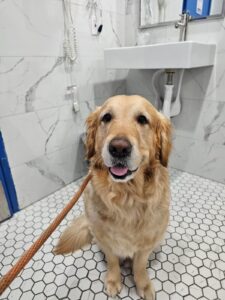
Rambo, a golden retriever, who made the trip from the USA to Australia
Step-by-step requirements for dogs (USA to Australia)
1) Microchip (first)
-
The microchip must be implanted before the most recent rabies vaccination and before blood sampling.
-
9-digit microchips are not accepted for dogs traveling from the USA, and microchips that begin with 999 are also not acceptable.
-
Your dog’s microchip must be ISO-compliant, typically a 10- or 15-digit microchip.
2) Rabies vaccination
-
The rabies vaccination must be administered by a government-approved veterinarian.
-
Your dog must be at least 84 days old at the time of vaccination.
-
If your dog’s rabies vaccination expires or lapses, your dog will not be eligible for export. Your dog will need to be revaccinated, and the 180-day waiting period will restart.
-
Rabies vaccines that are valid for three years may be acceptable if administered according to the manufacturer’s instructions and there has been no lapse in coverage.
3) Rabies titre test (RNATT/FAVN)
-
Blood draw: At least 3–4 weeks after the rabies vaccination, and within 12 months of entry.
-
If your dog receives a 3-year rabies vaccine, the RNATT can usually be performed at any time during that 3-year validity period, as long as there has been no lapse.
-
If the results are too low, your dog will need to be revaccinated, and the RNATT will need to be repeated.
-
-
A passing result must be 0.5 IU/mL or higher.
-
There is a mandatory 180-day wait starting from the date the blood sample is collected.
4) General vaccinations (dogs)
Your dog must be vaccinated against Canine Influenza Virus (CIV). This vaccination must be at least 14 days old and given within 1 year of export to Australia. The same timing requirement applies to the optional vaccines listed below.
Optional vaccinations may include:
-
Distemper
-
Hepatitis
-
Parvovirus
-
Parainfluenza
-
Bordetella (within 6 months)
These vaccinations must be completed as a full course, including a primary dose and a booster dose given 2–4 weeks apart.
5) Parasite treatments (scheduled)
External parasite treatments:
Administer 2–3 treatments leading up to export using an approved product (such as Frontline or K9 Advantix II). Treatment should begin at least 30 days before export.
Internal parasite treatments:
A government-accredited veterinarian must administer two internal parasite treatments within the 45 days before export. Only Drontal (Bayer) may be used. The two treatments must be at least 14 days apart, and the second treatment must be given within 5 days of the export date.
6) Additional blood tests (dogs)
The additional blood tests listed below are required for dogs entering Australia and must be completed by a government-accredited veterinarian:
-
Brucella canis: Not required if your dog is desexed. If required, your dog must receive a negative result, and the test must be completed within 45 days of export.
-
Leishmania infantum: Your dog must receive a negative result, and the test must be completed within 45 days of export.
-
Leptospira canicola (Leptospirosis): Your dog must receive a negative result, and the test must be completed within 45 days of export.
-
If your dog is fully vaccinated against leptospirosis, this test may not be required.
-
Documents you will need
-
RNATT Declaration (USDA endorsement): A USDA official government veterinarian must complete, sign, and stamp the RNATT Declaration.
-
Australian Import Permit: Processing times vary. Most permits are issued within 20–40 business days, but processing can take up to 123 business days.
-
Leishmania infantum laboratory report
-
Brucella canis laboratory report (if your dog is not desexed)
-
Leptospira interrogans serovar Canicola laboratory report or vaccination certificate
-
Canine influenza virus (CIV) vaccination certificate (if required)
-
Australian Health Certificate: Must be issued within 5 days before export and USDA-endorsed.
-
Fit-to-Fly certificate (APHIS 7001): Must be completed within 10 days before travel.
Quarantine and arrival


Moving your pet across the world just got less stressful. Valerie Neyra, Marketing Coordinator at WorldCare Pet and devoted cat mom to Lucky, creates the guides, tools, and resources pet parents need to navigate domestic and international pet transport with confidence. Her mission? Making sure no pet owner feels alone during a global move.