

Published on June 22, 2026
Last updated:
Introduction
Finding the right dog crate is one of the most important decisions you can make for your dog’s comfort and safety, whether you are setting up a cozy home base, road-tripping across the country, or preparing your pet for an international relocation. The right crate gives your dog a secure, familiar space that feels like theirs. The wrong size, though, can make the experience stressful for your dog and potentially non-compliant if air travel is in the picture.
This guide walks you through everything you need to know: crate types, how to measure your dog correctly, size recommendations by breed, puppy-specific considerations, travel and airline requirements, and how to choose the right crate for your situation. If your plans include air travel, our dedicated guide on airline-approved pet travel carriers goes deeper on IATA compliance and carrier selection for flights. If your dog will be flying as unaccompanied cargo, our guide to flying a dog alone covers how the booking process and safety standards work.
Understanding Dog Crate Types
Dog crates come in several styles, and each one is designed with a different use case in mind. Understanding the differences helps you choose the right tool for the situation.
Wire Crates
Wire crates are among the most popular for home use. They offer excellent ventilation, visibility on all sides, and most models fold flat for storage. Many come with a divider panel that allows you to adjust the interior space as a puppy grows, which makes them a practical long-term investment. Wire crates are well-suited for dogs who like to see their surroundings and for households where the crate serves as a permanent safe space.
One important note: wire crates are not accepted in aircraft cargo holds and are generally not approved for air travel under IATA standards. If you anticipate flying with your dog, a wire crate should be considered a home crate only.
Hard-Sided Plastic Kennels
Hard-sided plastic kennels are the gold standard for air travel. They are the crate type required for cargo hold transport under IATA Live Animal Regulations, and they are what most pet relocation professionals work with when coordinating international dog moves. Beyond air travel, they are durable, easy to clean, and provide a sense of enclosure that many dogs find calming.
When selecting a hard-sided kennel for air travel, the crate must be large enough for your dog to stand at full height without touching the ceiling, turn around completely, and lie down in a natural position. Our pet measuring guide walks through exactly how to take those measurements accurately.
Soft-Sided Crates
Soft-sided, fabric crates are lightweight and collapsible, making them convenient for short trips, dog-friendly events, or situations where portability is the priority. For in-cabin air travel on most major airlines, a soft-sided carrier is typically required since it needs to compress slightly to fit under the seat in front of you.
Soft-sided crates are not appropriate for cargo hold travel and are generally not suitable for dogs who are strong chewers or who become anxious in enclosed spaces. They work best for calm, crate-trained dogs on shorter journeys.
Heavy-Duty and Aluminum Crates
Heavy-duty aluminum and industrial-style crates are built for strength and are commonly used for working dogs, large breed dogs with a history of escaping standard crates, and vehicle transport such as truck bed kennels. They are exceptionally durable but are significantly heavier than plastic kennels, which makes them impractical for most air travel scenarios.
If your primary need is vehicle transport rather than air travel, a heavy-duty crate designed for truck beds or SUV cargo areas can be an excellent choice. These are typically ventilated on multiple sides and built to stay secured in a moving vehicle.
Crate Type At-a-Glance
| Crate Type | Best For | Airline / IATA Approved? | Key Consideration |
| Hard-sided plastic | Air travel, daily use | Yes (when properly fitted) | Must meet IATA size rules |
| Wire / metal | Home use, car travel | No | Not accepted in aircraft hold |
| Soft-sided fabric | In-cabin (small pets) | Cabin only, size limits apply | Airline dimensions vary |
| Heavy-duty aluminum | Working dogs, vehicles | Rarely | Too heavy for most airline cargo |
Dog Crate Sizes Explained
Crate sizing is one of the areas where pet owners most commonly go wrong, often choosing a crate that looks large enough but does not meet the specific space requirements that keep a dog comfortable and compliant for travel. The sizing rules are straightforward once you understand what to measure.
How to Measure Your Dog for a Crate
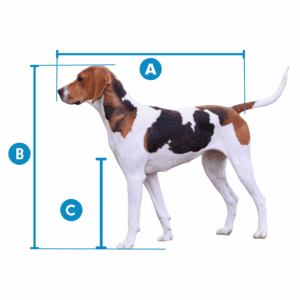 There are three measurements you need. Our full pet measuring guide includes an illustrated diagram and a step-by-step video to help you get this right:
- Length (A): Measure from the tip of your dog’s nose to the root of their tail (not the tip). Add 4 inches to this measurement to determine the minimum interior crate length.
- Height (B): Measure from the floor to the tallest point of your dog when standing, which is typically the top of the head or the tips of upright ears. Add 4 inches to this measurement for minimum interior crate height.
- Front leg length (C): Measure the length of your dog’s front legs from the floor to the elbow. This is used to confirm enough vertical headroom exists when your dog is lying down.
For IATA-compliant travel crates specifically, the standard requires at least 3 to 4 inches of clearance from the top of your dog’s head to the ceiling of the crate, and the same clearance from the nose to the front door when the dog is standing with their hindquarters against the back wall.
If you are unsure whether a crate you already own meets IATA requirements, the WorldCare Pet team can review your crate’s dimensions alongside your dog’s measurements. Simply share the carrier’s exterior dimensions, your dog’s three measurements, and a photo of your dog standing inside and next to the crate. Details are on our pet measuring page.
Size Recommendations by Weight and Breed
The table below provides general size guidance. Always verify with your dog’s individual measurements, since dogs of the same weight can vary considerably in height and length.
| Dog Weight | Crate Size | L x W x H (approx) | Example Breeds |
| Up to 25 lbs | Small (24″) | 24 x 18 x 19″ | Chihuahua, Shih Tzu, Maltese |
| 26–40 lbs | Medium (30″) | 30 x 19 x 21″ | Cocker Spaniel, Beagle, Corgi |
| 41–70 lbs | Intermediate (36″) | 36 x 23 x 25″ | Border Collie, Springer Spaniel |
| 71–90 lbs | Large (42″) | 42 x 28 x 30″ | Labrador, Golden Retriever, Boxer |
| 91–110 lbs | XL (48″) | 48 x 30 x 33″ | German Shepherd, Rottweiler |
| 110+ lbs | XXL (54″) | 54 x 37 x 45″ | Great Dane, Mastiff, Saint Bernard |
Note: These are general guidelines. Always size from your dog’s actual measurements rather than weight alone. A tall, lean dog may need a larger crate than their weight suggests, while a compact, stocky dog may fit comfortably in a smaller size.
A Note on Golden Retrievers and Similar Large Breeds
Golden Retrievers are a breed that pet owners frequently undersize for. A fully grown Golden typically weighs between 55 and 75 pounds, which might suggest a large (42-inch) crate, but many Goldens — particularly males — have long, fluffy tails and carry their head high, which can push them into the extra-large (48-inch) category when measured correctly. When in doubt, go up a size. A crate that is slightly too large is far better for your dog than one that is slightly too small, and for air travel it is better to have excess space than to fail an inspection at the airport.
Puppy Crate Considerations
Ideal Dimensions for Puppies
For puppies, the general advice is to size for the dog they will become rather than the dog they are now. A puppy crate that is too spacious, however, can work against house training, since dogs naturally avoid soiling their sleeping area and will use a far corner if given too much room. The practical solution is to purchase the crate that fits your dog’s adult size and use a divider panel to reduce the interior space while your puppy is young.
Most wire crates designed for home use include a divider panel for this reason. Hard-sided plastic crates typically do not, which means you may need a smaller crate for the puppy months and upgrade later, or use a wire crate with a divider for home training while reserving a properly sized hard-sided kennel for any travel needs.
Transitioning to a Larger Crate
As your puppy grows, watch for the signs that it is time to size up: pawing at the ceiling or sides, turning in a tight circle before lying down, or consistently lying with their nose pressed against the door. Any of these indicates the crate has become too small. A dog that is uncomfortable in their crate may begin to resist going in, which can undo crate training progress that took time to build.
Make the transition to a larger crate as positive as possible. Bring familiar bedding and toys from the old crate, feed your dog their first few meals in the new one, and let them explore it at their own pace before closing the door.
Puppy Travel Kennels
If you are traveling with a young dog or planning to relocate internationally with a puppy, a travel kennel takes on added importance. Airlines require that all dogs flying in the cargo hold are at least 8 weeks old (most require at least 15 to 16 weeks for international travel), and the crate must be IATA-compliant regardless of the dog’s age. Start crate training early and choose a hard-sided kennel that will accommodate your puppy’s adult size with room to grow, rather than buying a puppy-sized travel crate that will need replacing within months.
Special Use Cases
Travel Kennels for Air Transport
If flying with your dog is a current or future possibility, it is worth investing in an IATA-compliant hard-sided travel kennel from the start rather than purchasing a home crate and a separate travel crate later. The requirements for airline cargo transport are specific: the crate must be made of rigid, non-collapsible material; have ventilation on at least three sides; have secure locking mechanisms that cannot be accidentally opened; include food and water dishes accessible from outside without opening the door; and be sized to IATA standards. You can review the full IATA pet container requirements directly on IATA’s website. Our airline-approved pet carrier guide covers approved models and IATA requirements in detail.
It is also worth noting that regulations change. A crate that was airline-approved for a previous move may not meet current requirements for a new one. If you are planning a relocation and want to confirm whether your existing crate still qualifies, the WorldCare Pet team can verify this for you as part of the relocation planning process.
Portable Dog Kennels
Portable kennels are designed for use at dog-friendly destinations, outdoor events, camping trips, and situations where a temporary safe space is needed away from home. These range from lightweight pop-up fabric enclosures to collapsible wire panels that form a larger playpen area. They are not travel crates in the IATA sense and should not be used for air travel, but they are a practical addition to the toolkit of any owner who travels frequently with their dog by car.
Dog Crates for Truck Beds and Vehicles
Owners who transport dogs in truck beds or large SUVs often turn to aluminum or heavy-duty welded steel crates designed specifically for vehicle use. These are ventilated, weather-resistant, and engineered to stay secure during transit. They are not suitable for air travel due to their weight and construction, but for owners whose primary transport challenge is ground-based, they offer a level of durability and security that standard crates do not.
For vehicle safety, whatever crate style you choose, the crate should be secured so it cannot shift during sudden braking or a collision. Unsecured crates in vehicles are a safety risk for both the dog and the driver.
Where to Buy a Dog Crate
Physical Stores vs. Online Retailers
Pet specialty retailers such as PetSmart and Petco carry a solid range of wire crates, soft-sided carriers, and some plastic travel kennels. The advantage of purchasing in a physical store is the ability to see the crate’s construction quality firsthand and occasionally bring your dog to test the fit. The limitation is that airline-compliant hard-sided kennels in larger sizes are not always stocked in stores and are more reliably found online.
Online retailers including Amazon, Chewy, and directly through crate manufacturers offer the widest selection, particularly for large and extra-large hard-sided kennels. When purchasing online, pay close attention to interior dimensions rather than the crate’s size label, since sizing labels vary across brands. Always compare the interior measurements against your dog’s measurements before purchasing.
Evaluating Product Quality
For home crates, look for secure latches, smooth welds or seams with no sharp edges, and sturdy construction that will hold up to repeated use. For travel crates intended for air transport, confirm that the specific model you are considering is listed as IATA-compliant by the manufacturer and that the locking mechanism meets airline requirements. Not all hard-sided kennels sold as “airline approved” fully meet IATA cargo hold standards, which are more stringent than in-cabin requirements.
If you are purchasing a crate for international pet relocation and are unsure whether it meets requirements for your specific airline and route, this is one area where working with a pet relocation specialist pays dividends. WorldCare Pet reviews crates as part of our client intake process and can confirm compliance before you travel. Visit our pet travel FAQ for more on how this process works.
Tips for Crate Training and Travel Prep
Choosing the right crate is only part of the equation. How your dog feels about the crate matters just as much, particularly if travel is in the picture. A dog that associates their crate with comfort and safety will settle far more quickly during transport than one that is being placed in a crate for the first time at the airport.
- Introduce the crate gradually. Leave the door open and let your dog explore at their own pace before any confinement.
- Make the crate a positive space from the start. Feed meals inside it, toss treats in, and place familiar bedding so the smell is reassuring.
- Build up crate time incrementally, starting with short intervals and extending gradually before any travel.
- Avoid sedating your dog for crate travel. Most airlines prohibit sedation, and it can be dangerous at altitude. Our post on whether pets should be sedated for travel explains the reasoning and what calming alternatives exist.
- Exercise your dog before any crated travel to encourage rest rather than restlessness.
- Watch our video guide on how to measure your pet for the right travel carrier for a visual walkthrough of the sizing process.
Getting It Right Matters More Than You Might Expect
The stakes around crate selection are higher than many pet owners realize until they are standing at an airline check-in counter. A crate that is even a few inches too small for your dog’s measurements can result in denied boarding, which means rebooking, rescheduling documentation, and a stressful experience for everyone involved. Getting sizing right the first time is not just a comfort issue, it is a logistics issue.
If you are preparing for an international move or a complex domestic relocation with a large dog, the WorldCare Pet team is here to help make sure every detail, including crate selection, documentation, and airline coordination, is handled correctly. Explore our pet travel resources or request a free quote to start the conversation. We have been moving pets safely around the world for more than 25 years, and we would love to help your dog travel in comfort.

Kaitlyn Reid is a Marketing Assistant at WorldCare Pet, where she helps share stories, tips, and guidance for smooth pet relocations worldwide. A devoted dog mom to Piper, she combines her love for animals with her marketing expertise to connect pet parents with the information they need for stress-free moves. Her goal is to make every transferee’s journey as seamless and reassuring as possible.