

Published on September 11, 2026
Last updated:
Short answer: Four destinations, Finland, Ireland (including Northern Ireland), Malta, and Norway, require dogs to be treated against the tapeworm Echinococcus multilocularis before entry, because these areas are considered free of the parasite. The United Kingdom has its own version of this rule, but the exemptions run in one direction only: dogs traveling into Great Britain from those same five places skip the treatment, while dogs traveling from Great Britain into them still need it. The treatment must be given by a licensed veterinarian, between 24 and 120 hours before arrival, and recorded on the pet’s health certificate or passport. Cats and ferrets are not included in any version of this rule.
Below is the full picture for pet parents planning international travel with a dog.
Which Countries Require Tapeworm Treatment for Dogs?
| Destination | Requirement | ||
| Finland | Required (see exemption note below) | ||
| Ireland (including Northern Ireland) | Required (see exemption note below) | ||
| Malta | Required (see exemption note below) | ||
| Norway | Required (see exemption note below) | ||
| United Kingdom (Great Britain) | Required (see exemption note below) |
All requirements on this table apply to dogs only. Cats and ferrets are exempt.
All five destinations require the treatment 24 to 120 hours before arrival. Finland and Norway also allow a 28 day repeat-treatment schedule for dogs accompanied by their owner who travel that route regularly.
Exemptions here run in one direction and depend on which side of the list a country sits on. A dog can travel directly into Great Britain from Ireland, Northern Ireland, Finland, Malta, or Norway without the treatment. But traveling the other way, from Great Britain into Ireland, Finland, Malta, or Norway, does require it, since Great Britain itself isn’t on the EU’s recognized echinococcus-free list. Northern Ireland is treated as part of the EU-side group for this purpose, so NI to Ireland is exempt.
What Is Echinococcus Multilocularis, and Why Do These Countries Require Treatment?
Echinococcus multilocularis is a tiny tapeworm that dogs can carry without showing symptoms themselves. It’s zoonotic, meaning an infected dog can pass it to humans, typically through contact with feces or contaminated surfaces, though humans cannot pass it back. The parasite is established in fox and wildlife populations across much of continental Europe, but Finland, Ireland, Malta, Norway, and the UK have kept it out of their domestic animal and wildlife populations. Requiring treatment before entry is how they maintain that status. It’s a border health measure tied to each country’s parasite-free classification, not a reflection of a dog’s individual health.
Does the United Kingdom Have Its Own Rule?
Yes, though it shares the same exempt list as the EU side. The UK’s rule, set by the Animal and Plant Health Agency (APHA) post-Brexit, requires the treatment for dogs entering Great Britain from anywhere except Ireland, Northern Ireland, Finland, Malta, or Norway. A dog flying from the United States needs the treatment just as one traveling from mainland Europe does, but a dog coming directly from one of those five places does not.
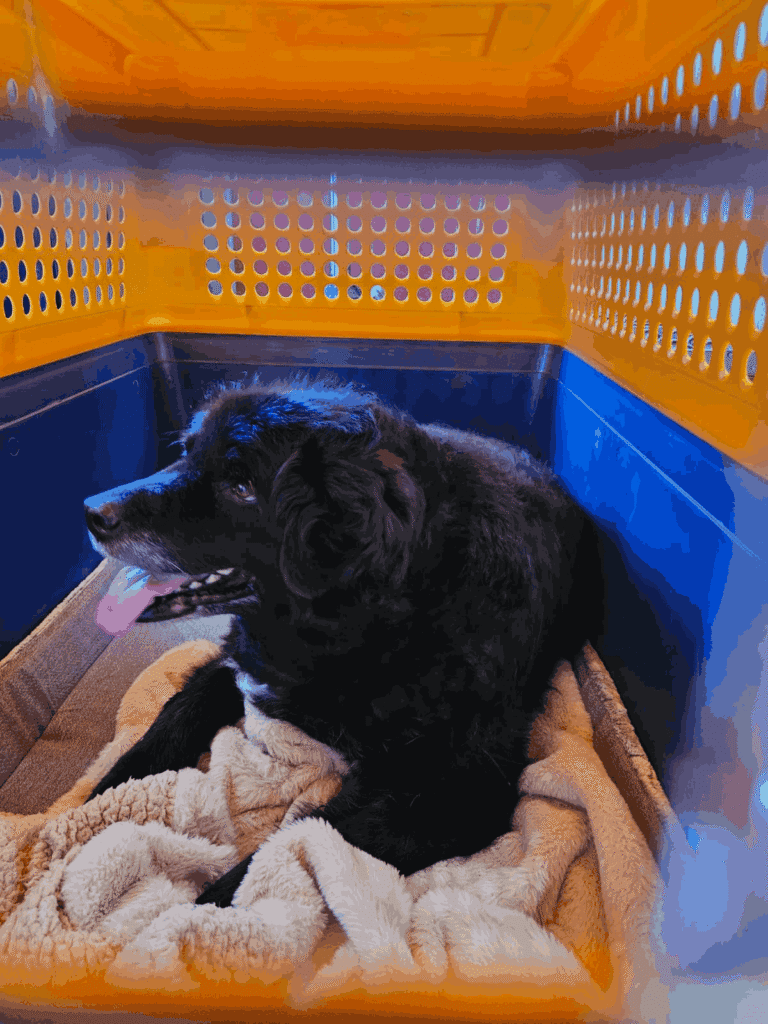
Scout, settled in and ready for the flight to the UK.
How and When Is the Tapeworm Treatment Given?
A licensed veterinarian administers a product containing praziquantel or an equivalent approved treatment. It cannot be given by the pet parent at home. The timing is fixed: no less than 24 hours and no more than 120 hours (1 to 5 days) before the dog’s scheduled arrival in the destination country. The vet then records the product name, date, and time on the dog’s EU health certificate, GB health certificate, or pet passport, since the paperwork is what border authorities check, not just the treatment itself.
What Happens If the Timing Is Off?
If the treatment falls outside the 24 to 120 hour window, whether given too early or too late, the paperwork does not meet the entry requirement. The dog can be refused entry, held in quarantine, or returned to its country of origin, and getting a compliant treatment redone typically means missing the original travel date. This is one of the most common paperwork issues with these specific destinations, and also one of the easiest to avoid with the right timeline.
Does This Requirement Apply to Cats or Ferrets?
No. The tapeworm treatment rule applies to dogs only. Cats and ferrets traveling to Finland, Ireland, Malta, Norway, or the UK follow the standard microchip, rabies vaccination, and health certificate requirements, with no additional tapeworm step.
Planning a Move to One of These Countries?
Getting the tapeworm treatment timed correctly means building it into the broader relocation timeline alongside the microchip, rabies vaccination, and health certificate steps, not treating it as a separate errand. WorldCare Pet Transport builds that timeline for pet parents moving to the UK, Ireland, Finland, and Norway, so the vet appointment lands in the right window relative to the actual travel date. Request a free quote to map out the paperwork for your route.

Moving your pet across the world just got less stressful. Valerie Neyra, Marketing Coordinator at WorldCare Pet and devoted cat mom to Lucky, creates the guides, tools, and resources pet parents need to navigate domestic and international pet transport with confidence. Her mission? Making sure no pet owner feels alone during a global move.